Dubai did not become a financial hub by accident—and it will not become an AI-driven financial powerhouse by hype alone. In our experience, cities that lead the next phase of financial innovation share three traits: regulatory clarity, access to global capital, and a cultural willingness to adopt systems over intuition. By 2026, Dubai will sit at the intersection of all three.
This is why Abhishek Mahankal believes Dubai is uniquely positioned to lead AI automation in financial services—and why his work with TRADR AI is deeply rooted in the region’s structural advantages rather than short-term trends.

Dubai’s Financial Ecosystem Is Built for Systems, Not Speculation
One of the most common misconceptions about AI in finance is that it thrives best in speculative environments. We’ve seen the opposite. AI automation works when markets reward process discipline, not emotional agility.
Dubai’s financial ecosystem—particularly within structured zones like DIFC—has been designed around:
- Clear compliance frameworks
- Institutional-grade governance
- Long-term capital participation
This matters because AI systems require stable rules to function effectively. Constant regulatory ambiguity breaks automation. Dubai reduces that friction.
In Mahankal’s view, this is the single biggest reason Dubai has accelerated past many older financial centres in adopting AI-led financial services.
Why 2026 Is a Turning Point for AI Automation
AI has been in finance for years, but 2026 marks a shift from experimentation to dependence. In our experience, three forces are converging:
Market Complexity Has Outpaced Human Reaction
Global capital flows, geopolitical shifts, and cross-asset correlations now change faster than manual decision-making can manage.
Investors Are Prioritising Consistency Over Excitement
After repeated volatility cycles, institutions and serious investors are demanding systems that protect capital rather than chase narratives.
Regulators Are More Comfortable with Automation
Dubai’s regulatory evolution has increasingly acknowledged that, when transparent, automation is safer than discretionary chaos.
These forces make AI automation less optional and more foundational.
Abhishek Mahankal’s Perspective: AI as Risk Infrastructure
Unlike many AI evangelists, Mahankal does not frame AI as a performance engine. He frames it as risk infrastructure.
In our experience, AI systems fail when they are built to “beat the market.” They succeed when they are built to:
- Enforce discipline
- Maintain consistency under pressure.
- Execute predefined logic without deviation.
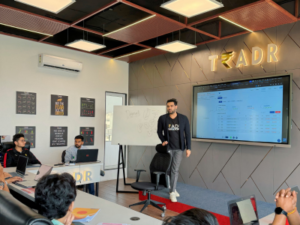
Abhishek mahanakal
This philosophy is embedded in TRADR AI’s design. Automation is not used to accelerate decisions, but to standardise them—a critical requirement in globally exposed markets like Dubai.
Why Dubai Attracts AI-First Financial Leadership
Dubai’s appeal for AI-led financial services goes beyond incentives or location. It attracts leaders who think structurally.
Mahankal points to three reasons Dubai draws AI-first founders and financial architects:
1. Global Capital with Long-Term Intent
Dubai’s investor base is less driven by short-term retail sentiment and more aligned with portfolio durability.
2. Cultural Acceptance of Automation
Automation here is seen as professionalism, not as a loss of control—a critical mindset shift that many markets still resist.
3. Cross-Border Financial Reality
Dubai portfolios are inherently global, making automation essential for managing exposure, currency risk, and regulatory overlap.
TRADR AI’s Role in Dubai’s Automation Shift
TRADR AI operates as an AI investment group designed for environments where failure of discipline is costlier than lack of opportunity.
Its systems focus on:
- Rule-based execution across market conditions
- Continuous risk monitoring rather than reactive intervention
- Portfolio logic that remains intact during volatility
In Dubai’s financial ecosystem, this approach aligns naturally with institutional expectations. AI is not a novelty—it is an operational necessity.
Common Misunderstandings About AI Automation in Dubai
From our work in this space, these are the most common misconceptions:
“AI removes risk.”
It doesn’t. It manages behaviour around risk.
“Automation replaces human judgment.”
It doesn’t. It protects it.
“AI is only for high-frequency trading.”
In reality, its most significant value is in portfolio stability and execution consistency.
Mahankal’s work consistently pushes back against these oversimplifications.
When Dubai’s AI Advantage Doesn’t Apply
AI automation is not universally beneficial. Mahankal is clear that this model is not suited for:
- Investors seeking discretionary control
- Speculative, short-term trading approaches
- Environments with unstable regulatory frameworks
Dubai is well-suited to AI because its financial architecture supports repeatable systems.
Looking Ahead: Dubai’s Role in the Future of Finance
By 2026, Dubai will not be competing on who adopts AI first—but on who applies it most responsibly. Financial services here are evolving toward transparency, structure, and system-led governance.
From Mahankal’s perspective, this evolution is inevitable. As markets grow more interconnected, human intuition alone will not scale. AI automation will define how capital is protected, deployed, and sustained.
Dubai’s advantage is not speed—it is readiness.
And that is why it is becoming the global reference point for AI automation in financial services.